- Published on
深入理解Go调度器:M 如何找工作(三)
- Authors

- Name
- Kevin
本文源码基于 go 1.20.3 版本,如有问题,欢迎指出。
更新时间:2023.08.11
首次发布:2023.08.07
M 的结构
M 是 OS 线程的实体,我们看几个比较重要的字段,包括:
- 用于执行调度的g0
- 用于信号处理的gsignal
- 线程本地存储tls
- 当前正在运行的curg
- 执行 Goroutine 时需要的本地资源p(如果没有执行,则为nil)
- 执行系统调用前上一次绑定的oldp【结束系统调用的时候,优化恢复上一次绑定的p】
- 表示自身状态的spinning
等等其他五十多个字段,包括关于 M 的调度信息、调试信息等。
// src/runtime/runtime2.go
type m struct {
	g0      *g     // g0主要用来记录工作线程使用的栈信息,在执行调度代码时使用g0
	gsignal       *g                // 用于信号处理的g
	tls           [tlsSlots]uintptr // 工作线程本地存储
	curg          *g       // 当前正在运行的 g,即用户创建的可运行的 g 放在这里执行
  p             puintptr // 执行Goroutine代码时绑定的p(如果没有执行,则为nil)
	nextp         puintptr // 【当 m 被唤醒时,首先绑定这个p】
	oldp          puintptr // G进入系统调用前上一次绑定的p
	spinning      bool // 自旋标志位(当 m 没有work 且 处于寻找 work 的状态)
	incgo         bool          // m 正在执行 cgo 调用
	// 没有 g 需要运行时,工作线程休眠在这个 park 成员上
  // 当有工作需要做时,其他工作线程通过 park 字段唤醒该工作线程
  park          note
	alllink       *m // 在 allm 上
	freelink      *m // 在 sched.freem 上
  ...
}
M 的创建
有两种场景需要创建 M:
- Go 程序启动时会创建主线程,主线程的第一个 M,即M0
- 当有新 G 创建,或者有可运行的 G,且还有空闲的 P,那么会调用
starm函数。startm函数会从 全局空闲M 队列取一个 M,和空闲的 P 绑定,执行G,如果没有空闲的M,就会通过newm创建一个。
M 的销毁
M 不会被销毁,但当 M 找不到工作或者找不到空闲的 P 时,会通过stopm进入休眠状态。那么,什么情况下会进入休眠状态呢?
有两种情况:
第一种:没有工作可做。
当 M 绑定的 P 没有可运行的 G 且 无法从其他 P 和 全局可运行 G 列表找到可运行的G 时,M 会尝试进入自旋状态。注意,进入自旋状态的M数量有限制,处于自旋状态的M数量最多为非空闲P的数量一半。
如果 M 在自旋状态没有找到可运行的 G 或者 未能进入自旋状态,就会直接进入休眠状态。【详见下面 M 如何工作部分。】
第二种:没有空闲的P。
当 M 执行的 G,进入系统调用,M 会主动与绑定的 P 解绑,当 G 退出系统调用时,M 会找一个空闲的 P 进行绑定,进而继续执行 G,但是如果找不到空闲的 P,此时 M 也会调用stopm进入休眠。
stopm函数会将休眠的 M 放入全局的空闲队列(sched.midle),等待其他工作线程唤醒 M 时,从列表中取。
M 的运行
M 需要与 P 绑定才能运行,且 M 与 P 有亲和性。
当 M 执行的 G 进入系统调用,M 与 P 会进行解绑,M 会将当前的 P 记录到 m.oldp 中;当 G 退出系统调用时,M 会尝试优先绑定 m.oldp 中的 P。
M 的状态
通过前面的分析,可以知道 M 有三种状态:运行,自旋、休眠,其关系如下:
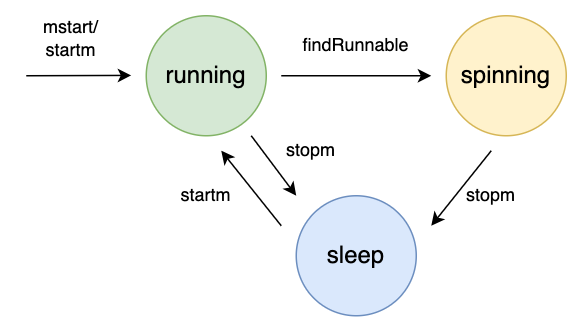
有些文章,将 M 的状态分为自旋和非自旋,主要从m.spinning来考虑。但笔者认为分成三种状态更易于理解,非自旋状态下,M 要么工作,要么休眠。
- 自旋状态:当 M 没有工作,且努力找工作的时候,就是自旋
- 运行状态:M 有工作处理
- 休眠状态:M 没有工作可做,或者无法进入自旋,就会进入休眠状态
M 如何找工作
下面,我们围绕 M 的状态,结合源码,分析下 M 是如何工作的。
我们知道 M 的职责就是找到一个可运行的 G,然后执行它。从大方向来讲,主要有三个过程:
- 先从本队队列中找
- 定期从全局队列中找
- 最后去别的 P 上偷
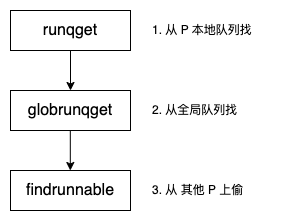
先看第一个过程,从 P 的本地队列找。源码分析如下:
// src/runtime/proc.go
// 从本队队列寻找一个可运行的 g
// 如果 inheritTime 为真,则 gp 应该继承当前时间片的剩余时间,否则新开一个时间片
// 只有绑定的 p可执行该函数
func runqget(pp *p) (gp *g, inheritTime bool) {
	// If there's a runnext, it's the next G to run.
  // 如果 runext 不为空,那么 runnext 就是下一个可运行的g
	next := pp.runnext
	// If the runnext is non-0 and the CAS fails, it could only have been stolen by another P,
	// because other Ps can race to set runnext to 0, but only the current P can set it to non-0.
	// Hence, there's no need to retry this CAS if it fails.
  // 如果 runnext 不为空,且 cas 失败,那么 runnext 只能是被其他p偷走了
  // 因为其他 p 可以将 runnext 置为零,但只有当前 p 可以将其置为非零。
  // 所以,当 cas 失败后,没有必要进行重试。
	if next != 0 && pp.runnext.cas(next, 0) {
    // 如果找到 runnext,则返回 runnext 所指向的指针,且继承时间片
		return next.ptr(), true
	}

	for {
    // 取本地队列的队头
		h := atomic.LoadAcq(&pp.runqhead) // load-acquire, synchronize with other consumers
		// 取队尾
    t := pp.runqtail
		if t == h {
      // 头尾相同,说明本地队列为空,找不到g
			return nil, false
		}
    // 取队头的g
		gp := pp.runq[h%uint32(len(pp.runq))].ptr()
    // 原子操作,防止这中间被其他线程因偷工作而修改
		if atomic.CasRel(&pp.runqhead, h, h+1) { // cas-release, commits consume
			return gp, false
		}
	}
}
整个代码还是比较简单,主要是两部分。
第一部分,先尝试获取 runnext,因为它的运行优先级更高。因为其他工作线程“偷工作”也是优先查看 runnext,所以这里用了原子操作。
第二部分,从本地队列中找。如果头尾相等,说明队列为空,直接返回。否则,取队头所指向的 g,并通过原子操作将队头指向下一个。原子操作同样为了避免其他工作线程因为“偷工作”而修改队头。
我们再来看第二个过程,从全局队列中获取 goroutine。需要说明的是,globrunqget函数的三次调用都在findRunnable函数中,其条件如下:
// src/runtime/proc.go
// 第一次调用
// Check the global runnable queue once in a while to ensure fairness.
// Otherwise two goroutines can completely occupy the local runqueue
// by constantly respawning each other.
// 为了公平,每调用 schedule 函数 61 次,才会从全局队列中获取 g
if pp.schedtick%61 == 0 && sched.runqsize > 0 {
  lock(&sched.lock)
  // 每次最多获取 1 个 goroutine
  gp := globrunqget(pp, 1)
  unlock(&sched.lock)
  if gp != nil {
    return gp, false, false
  }
}
这说明,并不是每次调度都会从全局队列中获取可运行的 g。实际情况是调度器每调度 61 次,且全局队列有可运行的 g 时,才会调用globrunqget函数从全局队列中获取。因为,从全局队列中获取需要上锁,开销有些大,能不做就不做。
其次,每次获取最多获取 1 个可运行的 g,这是为了保证从其他工作线程也能从全局队列中获取到可运行的 g。
好了,我们仔细看下 globrunqget 函数的内容。
该函数的第一个参数就是当前工作线程所绑定的 P,第二个参数max表示最多可从全局队列中取多少个 G 放到当前 P 的本地队列。
// src/runtime/proc.go
// Try get a batch of G's from the global runnable queue.
// sched.lock must be held.
// 尝试从全局队列中获取可运行的 g,必须上下锁。
// 最多获取 max 个,如果 max 为零,则不限制个数。
func globrunqget(pp *p, max int32) *g {
	assertLockHeld(&sched.lock)
  // 如果全局队列为空,直接返回
	if sched.runqsize == 0 {
		return nil
	}
  // 计算可供获取的个数 n
  // 全局队列中的个数/P的个数,加1,保证最少能获取 1 个
	n := sched.runqsize/gomaxprocs + 1
	if n > sched.runqsize {
		n = sched.runqsize
	}
  // 如果 max 有效,且可供获取的个数大于 max,取 max 个
	if max > 0 && n > max {
		n = max
	}
  // 最多获取 P 本地队列的一半,为了保证其他工作线程也能够获取到
	if n > int32(len(pp.runq))/2 {
		n = int32(len(pp.runq)) / 2
	}

	sched.runqsize -= n
	// 直接通过函数返回gp,其他的g通过runqput放入本地队列
	gp := sched.runq.pop()
	n--
	for ; n > 0; n-- {
    // 继续去队头,并放入 p 的本地队列
		gp1 := sched.runq.pop()
		runqput(pp, gp1, false)
	}
  // 返回队头所指向的 goroutine
	return gp
}
代码还是比较好理解的。
先根据全局队列可运行 g 的长度和 P 的个数,计算可供获取的 g 的个数,获得一个结果。
然后根据参数 max 和 P 的本地可运行队列的长度一半,修正上述结果。
最后,从全局队列中取,放入 P 的本地队列。
把全局队列中可运行的 g 转移到 P 的本地队列,保证了全局队列中可运行 g 的执行机会。这是从全局队列到本地队列的负载均衡。
知识点:
M 从 全局队列取的 G 的数据符合下面这个公式。
n = min(len(GRQ)/GOMAXPROCS + 1, len(LRQ)/2)
最后,我们看下第三个过程,从其他 P 中 “偷工作”。findRunnable函数只在调度函数schedule中出现。
这个函数有点长,我们一点点看。先看返回参数有三个:
- gp,即可运行的 goroutine,这是寻找的目标
- inheritTime,同上面介绍的一样,即是否需要继承时间片
- tryWakeP,表示 g 所在的 P 需要被唤醒
// src/runtime/proc.go
// Finds a runnable goroutine to execute.
// Tries to steal from other P's, get g from local or global queue, poll network.
// tryWakeP indicates that the returned goroutine is not normal (GC worker, trace
// reader) so the caller should try to wake a P.
func findRunnable() (gp *g, inheritTime, tryWakeP bool) {
  // 当前 g 所在的 m
	mp := getg().m

	// The conditions here and in handoffp must agree: if
	// findrunnable would return a G to run, handoffp must start
	// an M.

top:
  // 还记得吗?m 结构中的 p 表示 m 执行go代码时所绑定的p
	pp := mp.p.ptr()
	if sched.gcwaiting.Load() {
		gcstopm()
		goto top
	}
	if pp.runSafePointFn != 0 {
		runSafePointFn()
	}

	// now and pollUntil are saved for work stealing later,
	// which may steal timers. It's important that between now
	// and then, nothing blocks, so these numbers remain mostly
	// relevant.
	now, pollUntil, _ := checkTimers(pp, 0)

	// Try to schedule the trace reader.
	if trace.enabled || trace.shutdown {
		gp := traceReader()
		if gp != nil {
			casgstatus(gp, _Gwaiting, _Grunnable)
			traceGoUnpark(gp, 0)
			return gp, false, true
		}
	}

	// Try to schedule a GC worker.
  // 尝试调度 gc 工作线程,如果找到可运行的gc线程,返回gc线程
	if gcBlackenEnabled != 0 {
		gp, tnow := gcController.findRunnableGCWorker(pp, now)
		if gp != nil {
			return gp, false, true
		}
		now = tnow
	}

	// Check the global runnable queue once in a while to ensure fairness.
	// Otherwise two goroutines can completely occupy the local runqueue
	// by constantly respawning each other.
  // 这里前面介绍了,为了保证公平,定期地检查全局队列
  // 一定是调度 61 次 且 全局队列不为空,才会调用globrunqget,
  // 而且最多从全局队列中拿 1 个
	if pp.schedtick%61 == 0 && sched.runqsize > 0 {
		lock(&sched.lock)
		gp := globrunqget(pp, 1)
		unlock(&sched.lock)
		if gp != nil {
			return gp, false, false
		}
	}

	// Wake up the finalizer G.
	if fingStatus.Load()&(fingWait|fingWake) == fingWait|fingWake {
		if gp := wakefing(); gp != nil {
			ready(gp, 0, true)
		}
	}
	if *cgo_yield != nil {
		asmcgocall(*cgo_yield, nil)
	}

	// local runq
  // 从 p 的本地队列中寻找,如果找到,直接返回
	if gp, inheritTime := runqget(pp); gp != nil {
		return gp, inheritTime, false
	}

	// global runq
  // 这里是,只要全局队列不为空,就从全局队列中拿,且不限制个数
	if sched.runqsize != 0 {
		lock(&sched.lock)
		gp := globrunqget(pp, 0)
		unlock(&sched.lock)
		if gp != nil {
			return gp, false, false
		}
	}

	// Poll network.
	// This netpoll is only an optimization before we resort to stealing.
	// We can safely skip it if there are no waiters or a thread is blocked
	// in netpoll already. If there is any kind of logical race with that
	// blocked thread (e.g. it has already returned from netpoll, but does
	// not set lastpoll yet), this thread will do blocking netpoll below
	// anyway.
	if netpollinited() && netpollWaiters.Load() > 0 && sched.lastpoll.Load() != 0 {
		if list := netpoll(0); !list.empty() { // non-blocking
			gp := list.pop()
			injectglist(&list)
			casgstatus(gp, _Gwaiting, _Grunnable)
			if trace.enabled {
				traceGoUnpark(gp, 0)
			}
			return gp, false, false
		}
	}

	// Spinning Ms: steal work from other Ps.
	//
	// Limit the number of spinning Ms to half the number of busy Ps.
	// This is necessary to prevent excessive CPU consumption when
	// GOMAXPROCS>>1 but the program parallelism is low.
  // 如果 m 为自旋状态,或者 自旋m数小于忙碌的p个数一半
	if mp.spinning || 2*sched.nmspinning.Load() < gomaxprocs-sched.npidle.Load() {
		if !mp.spinning {
			mp.becomeSpinning()
		}

		gp, inheritTime, tnow, w, newWork := stealWork(now)
		if gp != nil {
			// Successfully stole.
      // 成功"偷到工作“,那么直接返回
			return gp, inheritTime, false
		}
		if newWork {
			// There may be new timer or GC work; restart to
			// discover.
			goto top
		}

		now = tnow
		if w != 0 && (pollUntil == 0 || w < pollUntil) {
			// Earlier timer to wait for.
			pollUntil = w
		}
	}

	// We have nothing to do.
	//
	// If we're in the GC mark phase, can safely scan and blacken objects,
	// and have work to do, run idle-time marking rather than give up the P.
	if gcBlackenEnabled != 0 && gcMarkWorkAvailable(pp) && gcController.addIdleMarkWorker() {
		node := (*gcBgMarkWorkerNode)(gcBgMarkWorkerPool.pop())
		if node != nil {
			pp.gcMarkWorkerMode = gcMarkWorkerIdleMode
			gp := node.gp.ptr()
			casgstatus(gp, _Gwaiting, _Grunnable)
			if trace.enabled {
				traceGoUnpark(gp, 0)
			}
			return gp, false, false
		}
		gcController.removeIdleMarkWorker()
	}

	// wasm only:
	// If a callback returned and no other goroutine is awake,
	// then wake event handler goroutine which pauses execution
	// until a callback was triggered.
	gp, otherReady := beforeIdle(now, pollUntil)
	if gp != nil {
		casgstatus(gp, _Gwaiting, _Grunnable)
		if trace.enabled {
			traceGoUnpark(gp, 0)
		}
		return gp, false, false
	}
	if otherReady {
		goto top
	}

	// Before we drop our P, make a snapshot of the allp slice,
	// which can change underfoot once we no longer block
	// safe-points. We don't need to snapshot the contents because
	// everything up to cap(allp) is immutable.
	allpSnapshot := allp
	// Also snapshot masks. Value changes are OK, but we can't allow
	// len to change out from under us.
	idlepMaskSnapshot := idlepMask
	timerpMaskSnapshot := timerpMask

	// return P and block
	lock(&sched.lock)
	if sched.gcwaiting.Load() || pp.runSafePointFn != 0 {
		unlock(&sched.lock)
		goto top
	}
	if sched.runqsize != 0 {
		gp := globrunqget(pp, 0)
		unlock(&sched.lock)
		return gp, false, false
	}
	if !mp.spinning && sched.needspinning.Load() == 1 {
		// See "Delicate dance" comment below.
		mp.becomeSpinning()
		unlock(&sched.lock)
		goto top
	}
  // 当前工作线程解除与 p 的绑定关系,准备去休眠
	if releasep() != pp {
		throw("findrunnable: wrong p")
	}
  // 将 p 放入空闲队列
	now = pidleput(pp, now)
	unlock(&sched.lock)

	// Delicate dance: thread transitions from spinning to non-spinning
	// state, potentially concurrently with submission of new work. We must
	// drop nmspinning first and then check all sources again (with
	// #StoreLoad memory barrier in between). If we do it the other way
	// around, another thread can submit work after we've checked all
	// sources but before we drop nmspinning; as a result nobody will
	// unpark a thread to run the work.
	//
	// This applies to the following sources of work:
	//
	// * Goroutines added to a per-P run queue.
	// * New/modified-earlier timers on a per-P timer heap.
	// * Idle-priority GC work (barring golang.org/issue/19112).
	//
	// If we discover new work below, we need to restore m.spinning as a
	// signal for resetspinning to unpark a new worker thread (because
	// there can be more than one starving goroutine).
	//
	// However, if after discovering new work we also observe no idle Ps
	// (either here or in resetspinning), we have a problem. We may be
	// racing with a non-spinning M in the block above, having found no
	// work and preparing to release its P and park. Allowing that P to go
	// idle will result in loss of work conservation (idle P while there is
	// runnable work). This could result in complete deadlock in the
	// unlikely event that we discover new work (from netpoll) right as we
	// are racing with _all_ other Ps going idle.
	//
	// We use sched.needspinning to synchronize with non-spinning Ms going
	// idle. If needspinning is set when they are about to drop their P,
	// they abort the drop and instead become a new spinning M on our
	// behalf. If we are not racing and the system is truly fully loaded
	// then no spinning threads are required, and the next thread to
	// naturally become spinning will clear the flag.
	//
	// Also see "Worker thread parking/unparking" comment at the top of the
	// file.
	wasSpinning := mp.spinning
  // 如果自旋状态下实在没有工作做,那么置为 非自旋,全局自旋m数减一
	if mp.spinning {
		mp.spinning = false
		if sched.nmspinning.Add(-1) < 0 {
			throw("findrunnable: negative nmspinning")
		}

		// Note the for correctness, only the last M transitioning from
		// spinning to non-spinning must perform these rechecks to
		// ensure no missed work. However, the runtime has some cases
		// of transient increments of nmspinning that are decremented
		// without going through this path, so we must be conservative
		// and perform the check on all spinning Ms.
		//
		// See https://go.dev/issue/43997.

		// Check all runqueues once again.
    // 休眠之前,为了确保没有错过工作要做,当 m 从自旋状态进入非自旋状态,再次检查一遍所有的p
    // 如果发现有工作要做,回到自旋状态,重新寻找
		pp := checkRunqsNoP(allpSnapshot, idlepMaskSnapshot)
		if pp != nil {
			acquirep(pp)
			mp.becomeSpinning()
			goto top
		}

		// Check for idle-priority GC work again.
    // 如果找到空闲的 gc 工作,则运行 gc 工作
		pp, gp := checkIdleGCNoP()
		if pp != nil {
			acquirep(pp)
			mp.becomeSpinning()

			// Run the idle worker.
			pp.gcMarkWorkerMode = gcMarkWorkerIdleMode
			casgstatus(gp, _Gwaiting, _Grunnable)
			if trace.enabled {
				traceGoUnpark(gp, 0)
			}
			return gp, false, false
		}

		// Finally, check for timer creation or expiry concurrently with
		// transitioning from spinning to non-spinning.
		//
		// Note that we cannot use checkTimers here because it calls
		// adjusttimers which may need to allocate memory, and that isn't
		// allowed when we don't have an active P.
		pollUntil = checkTimersNoP(allpSnapshot, timerpMaskSnapshot, pollUntil)
	}

	// Poll network until next timer.
	if netpollinited() && (netpollWaiters.Load() > 0 || pollUntil != 0) && sched.lastpoll.Swap(0) != 0 {
		sched.pollUntil.Store(pollUntil)
		if mp.p != 0 {
			throw("findrunnable: netpoll with p")
		}
		if mp.spinning {
			throw("findrunnable: netpoll with spinning")
		}
		// Refresh now.
		now = nanotime()
		delay := int64(-1)
		if pollUntil != 0 {
			delay = pollUntil - now
			if delay < 0 {
				delay = 0
			}
		}
		if faketime != 0 {
			// When using fake time, just poll.
			delay = 0
		}
		list := netpoll(delay) // block until new work is available
		sched.pollUntil.Store(0)
		sched.lastpoll.Store(now)
		if faketime != 0 && list.empty() {
			// Using fake time and nothing is ready; stop M.
			// When all M's stop, checkdead will call timejump.
			stopm()
			goto top
		}
		lock(&sched.lock)
		pp, _ := pidleget(now)
		unlock(&sched.lock)
		if pp == nil {
			injectglist(&list)
		} else {
			acquirep(pp)
			if !list.empty() {
				gp := list.pop()
				injectglist(&list)
				casgstatus(gp, _Gwaiting, _Grunnable)
				if trace.enabled {
					traceGoUnpark(gp, 0)
				}
				return gp, false, false
			}
			if wasSpinning {
				mp.becomeSpinning()
			}
			goto top
		}
	} else if pollUntil != 0 && netpollinited() {
		pollerPollUntil := sched.pollUntil.Load()
		if pollerPollUntil == 0 || pollerPollUntil > pollUntil {
			netpollBreak()
		}
	}
  // m 进入休眠状态
	stopm()
	goto top
}
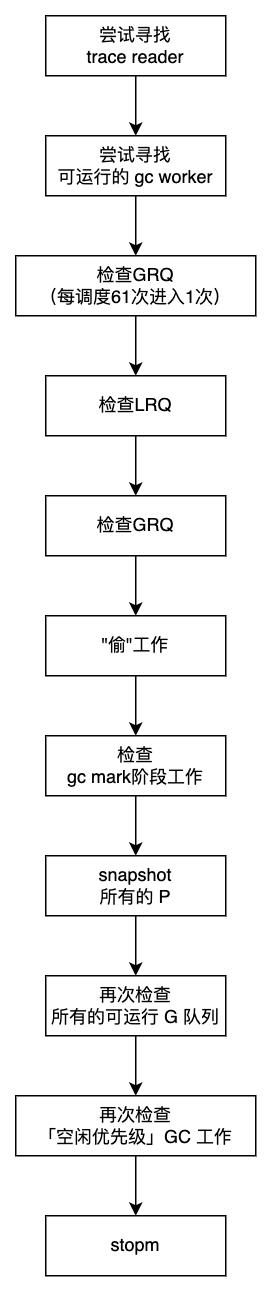
这部分最能说明 M 找工作的精神:尽力从本地队列 或 全局队列中寻找工作,如果实在找不到再进入休眠状态,等待有工作时,被其他 M 唤醒。
另外,阅读这部分源码需要注意每个return的部分。先看前两个。
第一个地方,如果找到 traceReader,则直接trace工作。这说明 trace 优先级最高。
第二个地方,检查 gc 工作,如果有,则执行 gc 工作。
紧接着,先周期性地检查全局队列。
然后,先从 p 本地队列找寻找 goroutine,如果找不到,再去全局队列中寻找;实在找不到,就只能去”偷“了。
为了避免 GOMAXPROCS很大,但程序并发很小情况下,过多的 m 进入自旋状态,所以限制了 自旋状态的个数,不超过 忙碌 P 的一半。
如果成功”偷“到了,那么执行偷来的工作。
如果没有偷到呢?如果没偷到,依然有工作可以做。
如果当前正处在 gc 的标记阶段,那么安全地扫描和标记对象,所以依然有工作可以做。看看人家这是什么精神。
如果依然没有工作要做,在放弃 P 之前,对所有的 P 做一次快照。
然后,才释放P,将其放入空闲队列。
如果 M 是自旋状态,那么再次检查所有的可运行队列,检查「空闲优先级」的 gc 工作。
如果没有工作可做,才会 stopm。
整个过程的流程图如下。
这个过程涉及三个关键点,分别是”怎么偷“,”解除 P 与 M 的关联“,以及“进入休眠”。
怎么偷
我们看下stealWork函数的源码。
// src/runtime/proc.go
// stealWork attempts to steal a runnable goroutine or timer from any P.
// 尝试从任何一个 P 中偷一个可运行的 G 或者 时间
// If newWork is true, new work may have been readied.
//
// If now is not 0 it is the current time. stealWork returns the passed time or
// the current time if now was passed as 0.
// 尝试从任何一个 P 中偷一个可运行的 G 或者 时间.
// 如果 newWork 为真,表示有可运行的 G.
func stealWork(now int64) (gp *g, inheritTime bool, rnow, pollUntil int64, newWork bool) {
	pp := getg().m.p.ptr()

	ranTimer := false

	const stealTries = 4
	for i := 0; i < stealTries; i++ {
		stealTimersOrRunNextG := i == stealTries-1

		for enum := stealOrder.start(fastrand()); !enum.done(); enum.next() {
			if sched.gcwaiting.Load() {
				// GC work may be available.
				return nil, false, now, pollUntil, true
			}
			p2 := allp[enum.position()]
			if pp == p2 {
				continue
			}

			// Steal timers from p2. This call to checkTimers is the only place
			// where we might hold a lock on a different P's timers. We do this
			// once on the last pass before checking runnext because stealing
			// from the other P's runnext should be the last resort, so if there
			// are timers to steal do that first.
			//
			// We only check timers on one of the stealing iterations because
			// the time stored in now doesn't change in this loop and checking
			// the timers for each P more than once with the same value of now
			// is probably a waste of time.
			//
			// timerpMask tells us whether the P may have timers at all. If it
			// can't, no need to check at all.
			if stealTimersOrRunNextG && timerpMask.read(enum.position()) {
				tnow, w, ran := checkTimers(p2, now)
				now = tnow
				if w != 0 && (pollUntil == 0 || w < pollUntil) {
					pollUntil = w
				}
				if ran {
					// Running the timers may have
					// made an arbitrary number of G's
					// ready and added them to this P's
					// local run queue. That invalidates
					// the assumption of runqsteal
					// that it always has room to add
					// stolen G's. So check now if there
					// is a local G to run.
					if gp, inheritTime := runqget(pp); gp != nil {
						return gp, inheritTime, now, pollUntil, ranTimer
					}
					ranTimer = true
				}
			}

			// Don't bother to attempt to steal if p2 is idle.
			if !idlepMask.read(enum.position()) {
				if gp := runqsteal(pp, p2, stealTimersOrRunNextG); gp != nil {
					return gp, false, now, pollUntil, ranTimer
				}
			}
		}
	}

	// No goroutines found to steal. Regardless, running a timer may have
	// made some goroutine ready that we missed. Indicate the next timer to
	// wait for.
	return nil, false, now, pollUntil, ranTimer
}
从函数可以看到这样几点:
- 最多尝试偷4次,即第一个 for 循环
- 从其他 P “偷工作”也是通过
runqget函数,只不过传入的参数为其他 P
解除 P 与 M 的关联
当实在没有工作可做是,就会解除与 P 的绑定,我们看下releasep函数,解除绑定都做了啥。
// src/runtime/proc.go
// Disassociate p and the current m.
func releasep() *p {
	gp := getg()

	if gp.m.p == 0 {
		throw("releasep: invalid arg")
	}
	pp := gp.m.p.ptr()
	if pp.m.ptr() != gp.m || pp.status != _Prunning {
		print("releasep: m=", gp.m, " m->p=", gp.m.p.ptr(), " p->m=", hex(pp.m), " p->status=", pp.status, "\n")
		throw("releasep: invalid p state")
	}
	if trace.enabled {
		traceProcStop(gp.m.p.ptr())
	}
  // 将各自的引用都置为零
	gp.m.p = 0
	pp.m = 0
	pp.status = _Pidle // 将 P 标记为 Pidle 状态
	return pp
}
前面都是一些合法性校验,主要工作就是将 M/P 互相引用的字段清空,并将 P 的状态置为_Pidle。
一旦释放P,P 变为空闲状态,进而会放入全局的空闲列表。
// src/runtime/proc.go
// 将 P 放到 空闲列表
func pidleput(pp *p, now int64) int64 {
	assertLockHeld(&sched.lock)

	if !runqempty(pp) {
		throw("pidleput: P has non-empty run queue")
	}
	if now == 0 {
		now = nanotime()
	}
	updateTimerPMask(pp) // clear if there are no timers.
	idlepMask.set(pp.id)
  // 将 p.link 指向 sched.pidle所指向的 p,也就是空闲列表的第一个p
	pp.link = sched.pidle
  // 更新 sched.pidle
	sched.pidle.set(pp)
  // 全局空闲 p 数量加1
	sched.npidle.Add(1)
	if !pp.limiterEvent.start(limiterEventIdle, now) {
		throw("must be able to track idle limiter event")
	}
	return now
}
所有的空闲 p 以链表的方式存储。整个构造过程是,先讲 p.link 指向 sched.pidle(表头)所指向的 p,然后在更新 sched.pidle,使其指向当前 p,这样链表就构造完成了。
进入休眠
接下来,要进入休眠了,这部分主要是stopm函数
// 休眠,要停止执行工作,
// src/routime/proc.go
// 停止执行工作,直到有新的工作可做为止。
func stopm() {
	gp := getg()

	if gp.m.locks != 0 {
		throw("stopm holding locks")
	}
	if gp.m.p != 0 {
		throw("stopm holding p")
	}
	if gp.m.spinning {
		throw("stopm spinning")
	}
  // 上锁,将 m 放到全局空闲队列中,下锁
	lock(&sched.lock)
	mput(gp.m)
	unlock(&sched.lock)
  // m 进入休眠
	mPark()
  // 将 m 与 nextp 关联起来,前面讲过,m 被唤醒后,首先绑定nextp,所以这里关联一下
	acquirep(gp.m.nextp.ptr())
	gp.m.nextp = 0
}
mPark里面就两个函数,notesleep函数使当前工作线程进入休眠状态。其他工作线程在检测到“当前有很多工作要做”,会调用noteclear将其唤醒。
func mPark() {
	gp := getg()
	notesleep(&gp.m.park)
	noteclear(&gp.m.park)
}
还记得 park 字段吗?它是一个note,结构很简单只有一个key字段。
type note struct {
	key uintptr
}
note 的底层实现机制跟操作系统相关,不同系统使用不同的机制,比如 linux 下使用的 futex 系统调用,而 mac 下则是使用的 pthread_cond_t 条件变量,note 对这些底层机制做了一个抽象和封装。
这种封装给扩展性带来了很大的好处,比如当睡眠和唤醒功能需要支持新平台时,只需要在 note 层增加对特定平台的支持即可,不需要修改上层的任何代码。
上面这一段来自阿波张的系列教程。我们接着来看下 notesleep 的实现:
// src/runtime/lock_sema.go
func notesleep(n *note) {
	gp := getg()
	if gp != gp.m.g0 {
		throw("notesleep not on g0")
	}
	semacreate(gp.m)
	if !atomic.Casuintptr(&n.key, 0, uintptr(unsafe.Pointer(gp.m))) {
		// Must be locked (got wakeup).
		if n.key != locked {
			throw("notesleep - waitm out of sync")
		}
		return
	}
	// Queued. Sleep.
  // 入队了,开始休眠
  // 表示 m 被阻塞了
	gp.m.blocked = true
  // 注意这里分了两种
	if *cgo_yield == nil { // 如果 cgo 调用为空,-1 表示无限期休眠
		semasleep(-1)
	} else {
		// Sleep for an arbitrary-but-moderate interval to poll libc interceptors.
    // 这里之所以需要用一个循环,是因为 futexsleep 有可能意外从睡眠中返回,
	  // 所以 futexsleep 函数返回后还需要检查 note.key 是否还是 0,
	  // 如果是 0 则表示并不是其它工作线程唤醒了我们,
	  // 只是 futexsleep 意外返回了,需要再次调用 futexsleep 进入睡眠
		const ns = 10e6
		for atomic.Loaduintptr(&n.key) == 0 {
			semasleep(ns)
			asmcgocall(*cgo_yield, nil)
		}
	}
  // 一旦,note.key 不为 0,表示其他工作线程唤醒了我们,
  // 将 阻塞 放开
	gp.m.blocked = false
}
我们继续看下noteclear,负责将 note.key 置零。
// src/runtime/proc.go
// One-time notifications.
func noteclear(n *note) {
	if GOOS == "aix" {
		// On AIX, semaphores might not synchronize the memory in some
		// rare cases. See issue #30189.
		atomic.Storeuintptr(&n.key, 0)
	} else {
		n.key = 0
	}
}
至此,找不到工作的 M 就休眠了。当其他工作线程发现有工作要做时,就会找到空闲的 M,再通过 m.park 字段唤醒本线程。
唤醒之后,回到findRunnable函数,继续寻找 g,找到后返回 schedule 函数,然后去执行找到的 g。
这就是 M 找工作的过程,真不简单呀。
startm
最后,再看下startm函数,这是启动 M 的过程。
// src/runtime/proc.go
// 调度 M 运行 P,必要时可以创建 M。
// Schedules some M to run the p (creates an M if necessary).
// If p==nil, tries to get an idle P, if no idle P's does nothing.
// May run with m.p==nil, so write barriers are not allowed.
// If spinning is set, the caller has incremented nmspinning and must provide a
// P. startm will set m.spinning in the newly started M.
// 如果 spinning 被设置,说明调用者递增了 自旋M 数,而且必须提供 P,所以这个情况 P 不能为空。
//
// Callers passing a non-nil P must call from a non-preemptible context. See
// comment on acquirem below.
//
// Must not have write barriers because this may be called without a P.
//
//go:nowritebarrierrec
func startm(pp *p, spinning bool) {
  // 取一个 M
	mp := acquirem()
	lock(&sched.lock)
	if pp == nil {
		if spinning {
			// TODO(prattmic): All remaining calls to this function
			// with _p_ == nil could be cleaned up to find a P
			// before calling startm.
			throw("startm: P required for spinning=true")
		}
    // 从空闲列表中取一个 P
		pp, _ = pidleget(0)
    // 如果没取到 P,啥也不做,直接返回。
		if pp == nil {
			unlock(&sched.lock)
			releasem(mp)
			return
		}
	}
  // 到这里,已经找到 P 了
  // 从全局空闲M列表中取一个 M
	nmp := mget()
	if nmp == nil {
		// No M is available, we must drop sched.lock and call newm.
		// However, we already own a P to assign to the M.
		//
		// Once sched.lock is released, another G (e.g., in a syscall),
		// could find no idle P while checkdead finds a runnable G but
		// no running M's because this new M hasn't started yet, thus
		// throwing in an apparent deadlock.
		//
		// Avoid this situation by pre-allocating the ID for the new M,
		// thus marking it as 'running' before we drop sched.lock. This
		// new M will eventually run the scheduler to execute any
		// queued G's.
    // 翻译过来:如果没有 M 可用,其他 G 也发现这种情况,尝试创建 M,但这个 M 还没有创建出来
    // 为了避免这种情况,通过 ID 来解决
		id := mReserveID()
		unlock(&sched.lock)

		var fn func()
		if spinning {
			// The caller incremented nmspinning, so set m.spinning in the new M.
			fn = mspinning
		}
    // 用 自旋函数 创建一个 M
		newm(fn, pp, id)
		// Ownership transfer of pp committed by start in newm.
		// Preemption is now safe.
		releasem(mp)
		return
	}
  // 从全局空闲M列表取到一个M
	unlock(&sched.lock)
	if nmp.spinning {
		throw("startm: m is spinning")
	}
	if nmp.nextp != 0 {
		throw("startm: m has p")
	}
	if spinning && !runqempty(pp) {
		throw("startm: p has runnable gs")
	}
	// The caller incremented nmspinning, so set m.spinning in the new M.
  // 设置 M 的自旋状态
	nmp.spinning = spinning
  // 将 P 设为 M 唤醒后优先绑定的P
	nmp.nextp.set(pp)
  // 通过 park 唤醒 M
	notewakeup(&nmp.park)
	// Ownership transfer of pp committed by wakeup. Preemption is now
	// safe.
	releasem(mp)
}
总结一下:
startm首先检查有没有空闲的 P 可以绑定,如果没有,啥也不做,直接返回;- 如果找到空闲的 P,再从空闲 M 列表找,如果没有空闲的 M,就会创建一个,然后返回。
- 否则,将找到的空闲的 P 设置为 M 的 nextp,并将 M 唤醒。
M0 的创建
我们再看下 mstart()。
// mstart is the entry-point for new Ms.
// It is written in assembly, uses ABI0, is marked TOPFRAME, and calls mstart0.
func mstart()
这是 M 创建的入口,是用汇编写的,标记为TOPFRAME。
所以,Go 程序启动的时候,会先进到这里。
继续,看下mstart0。
// mstart0 is the Go entry-point for new Ms.
func mstart0() {
	gp := getg()

	osStack := gp.stack.lo == 0
	if osStack {
		// Initialize stack bounds from system stack.
		// Cgo may have left stack size in stack.hi.
		// minit may update the stack bounds.
		//
		// Note: these bounds may not be very accurate.
		// We set hi to &size, but there are things above
		// it. The 1024 is supposed to compensate this,
		// but is somewhat arbitrary.
		size := gp.stack.hi
		if size == 0 {
			size = 8192 * sys.StackGuardMultiplier
		}
		gp.stack.hi = uintptr(noescape(unsafe.Pointer(&size)))
		gp.stack.lo = gp.stack.hi - size + 1024
	}
	// Initialize stack guard so that we can start calling regular
	// Go code.
	gp.stackguard0 = gp.stack.lo + _StackGuard
	// This is the g0, so we can also call go:systemstack
	// functions, which check stackguard1.
	gp.stackguard1 = gp.stackguard0
	mstart1()

	// Exit this thread.
	if mStackIsSystemAllocated() {
		// Windows, Solaris, illumos, Darwin, AIX and Plan 9 always system-allocate
		// the stack, but put it in gp.stack before mstart,
		// so the logic above hasn't set osStack yet.
		osStack = true
	}
	mexit(osStack)
}

// The go:noinline is to guarantee the getcallerpc/getcallersp below are safe,
// so that we can set up g0.sched to return to the call of mstart1 above.
//
//go:noinline
func mstart1() {
	gp := getg()

	if gp != gp.m.g0 {
		throw("bad runtime·mstart")
	}

	// Set up m.g0.sched as a label returning to just
	// after the mstart1 call in mstart0 above, for use by goexit0 and mcall.
	// We're never coming back to mstart1 after we call schedule,
	// so other calls can reuse the current frame.
	// And goexit0 does a gogo that needs to return from mstart1
	// and let mstart0 exit the thread.
	gp.sched.g = guintptr(unsafe.Pointer(gp))
	gp.sched.pc = getcallerpc()
	gp.sched.sp = getcallersp()

	asminit()
	minit()

	// Install signal handlers; after minit so that minit can
	// prepare the thread to be able to handle the signals.
  // 启动 M0
	if gp.m == &m0 {
		mstartm0()
	}

	if fn := gp.m.mstartfn; fn != nil {
		fn()
	}

	if gp.m != &m0 {
		acquirep(gp.m.nextp.ptr())
		gp.m.nextp = 0
	}
  // 开始调度
	schedule()
}
M0 的作用
如前所述,M0 是go runtime 创建的第一个系统线程(即主线程),一个 Go 进程只有一个 M0。
从「数据结构」看,M0 跟其他 M 没有区别,都是m结构。
从「创建」看,M0 是一个全局变量,在 src/runtime/proc.go 定义,M0 不需要在堆上分配内存,其他 M 都是通过 new(m) 创建出来的对象,其内存是从堆上进行分配的。
另外,从mstart代码看,M0 是进程在启动时由汇编创建的,而其他 M 都是go runtime创建的。
从「作用」看,M0 负责执行初始化操作和启动第一个 G,Golang 程序启动时会首先启动 M0,M0 和主线程进行了绑定,当 M0 启动第一个 G 即 main goroutine 后功能就和其他的 M 一样了 。
其他函数分析
关于 M,还有几个函数没有分析,我们也依次看下。
第一个函数是runqput,该函数将可运行的 G 放到 P 的本地队列。
runqput
该函数的第一个参数pp,表示当前绑定的P,第二个参数g,表示可运行的G,第三个参数next,true表示将 g 放入p.runnext,否则放入p.runq队列。
// src/runtime/proc.go#L5957

// runqput tries to put g on the local runnable queue.
// If next is false, runqput adds g to the tail of the runnable queue.
// If next is true, runqput puts g in the pp.runnext slot.
// If the run queue is full, runnext puts g on the global queue.
// Executed only by the owner P.
func runqput(pp *p, gp *g, next bool) {
	if randomizeScheduler && next && fastrandn(2) == 0 {
		next = false
	}

	if next {
	retryNext:
		oldnext := pp.runnext
    // 如果没有放入成功,继续尝试
		if !pp.runnext.cas(oldnext, guintptr(unsafe.Pointer(gp))) {
			goto retryNext
		}
    // 放入成功,且之前为0,表示当前绑定的 P,已经将runnext设置完成,直接返回
		if oldnext == 0 {
			return
		}
		// Kick the old runnext out to the regular run queue.
    // 否则,将其原来的 runnetx 放到普通的LRQ
		gp = oldnext.ptr()
	}

retry:
  // 取 LRQ 队头
	h := atomic.LoadAcq(&pp.runqhead) // load-acquire, synchronize with consumers
  // 取 LRQ 队尾
	t := pp.runqtail
  // 如果 LRQ 队列未满,直接放入队尾,且队尾向后移动一个
	if t-h < uint32(len(pp.runq)) {
		pp.runq[t%uint32(len(pp.runq))].set(gp)
		atomic.StoreRel(&pp.runqtail, t+1) // store-release, makes the item available for consumption
		return
	}
 	// LRQ 队列满了,runqputslow 负责将LRQ中 1/2 的 g 放入GRQ
	if runqputslow(pp, gp, h, t) {
		return
	}
	// the queue is not full, now the put above must succeed
  // LRQ 未满,继续尝试存放
	goto retry
}
总结一下:
runnext具备高优先级,通过next开关控制放入runnext还是runq- 由 p 中的runq, runqhead, runqtail组成的无锁循环队列,存放可运行的g
- 如果存放过程中 LRQ 队列满了,则将部分 g 放入 GRQ
runqput将新加入的 g 放到了队尾
接着,继续看下runqputslow函数。
// src/runtime/proc.go#L5995
// Put g and a batch of work from local runnable queue on global queue.
// Executed only by the owner P.
func runqputslow(pp *p, gp *g, h, t uint32) bool {
	var batch [len(pp.runq)/2 + 1]*g

	// First, grab a batch from local queue.
  // 取 LRQ 队列中一半的g
	n := t - h
	n = n / 2
	if n != uint32(len(pp.runq)/2) {
		throw("runqputslow: queue is not full")
	}
  // 将一半的 g 放入临时 batch 数组
	for i := uint32(0); i < n; i++ {
		batch[i] = pp.runq[(h+i)%uint32(len(pp.runq))].ptr()
	}
	if !atomic.CasRel(&pp.runqhead, h, h+n) { // cas-release, commits consume
		return false
	}
	batch[n] = gp
  // 如果随机调度开关打开,将 batch 数组随机一下
	if randomizeScheduler {
		for i := uint32(1); i <= n; i++ {
			j := fastrandn(i + 1)
			batch[i], batch[j] = batch[j], batch[i]
		}
	}

	// Link the goroutines.
  // 将 g  链接起来
	for i := uint32(0); i < n; i++ {
		batch[i].schedlink.set(batch[i+1])
	}
  // 放入临时 gQueue 队列
	var q gQueue
	q.head.set(batch[0])
	q.tail.set(batch[n])

	// Now put the batch on global queue.
  // 放入 临时队列 放入 GRQ
	lock(&sched.lock)
	globrunqputbatch(&q, int32(n+1))
	unlock(&sched.lock)
	return true
}
总结一下,runqputslow就是将 LRQ 队列中靠近头的一半 g 放入 GRQ,如果随机调度打开,将 g 的顺序随机打乱一次。